Q1. When will this Part-Passing System come in Action?
Answer:-
It is appropriate to introduce the part-passing system from the 38th National Examination for Care Workers scheduled to be held in January 2026. Continued adequate coordination with the Japan Center for Social Welfare Promotion and Examinations (JCWEP) is required.
Short introduction
Japan needs to secure approximately 570,000 new long-term care workers by the end of the 2040s (based on the 9th Long-Term Care Insurance Business Plan).
In Japan, it is estimated that approximately 570,000 new long-term care workers will be required by the end of 2040 (based on the 9th Long-Term Care Insurance Business Plan), and that the number of elderly people with dementia and elderly single-person households is on the rise.
In addition, the need to meet the increasingly complex and diverse needs of elderly people with dementia and elderly single-person households has made it an urgent issue to secure and train highly specialized nursing care personnel.
The need to secure and train highly specialized caregivers has become a pressing issue.
The National Examination for Care Workers (hereafter referred to as the “National Examination”) has become more important than ever before. The importance of the National Examination for Care Workers (hereinafter referred to as the “National Examination”) is increasing more than ever.
However, the number of examinees for the National Examination has been on a downward trend since 94,610 examinees took the 31st National Examination (FY 2008),
However, the number of people taking the national exam has been on a downward trend since the 31st exam (FY 2008) with 94,610 applicants. If the number of people who want to become care workers continues to decline, it will hinder the continuous provision of high quality care services.
If the number of people seeking to become care workers continues to decline, there is concern that this will hinder the continuous provision of high-quality care services.
More than 80% of examinees for the national examination take the work experience route, which requires three years of work experience and the prescribed training.
However, more than 80% of the examinees take the work experience route, which requires three years of work experience and prescribed training, while working in the nursing care field to obtain certification.
However, some examinees who took the work experience route said that it was a challenge for them to balance work and study for the exam, as they were trying to obtain the certification while working in the nursing care field.
In addition, the acceptance of foreign nursing care workers has been expanded in stages since 2009.
In particular, “nursing care workers” are allowed to work in Japan without restriction on their period of stay and to bring their family members with them.
In particular, the “Nursing Care Worker” visa status allows people to work in Japan for an unlimited period of stay, and also allows them to bring their family members.
In addition to specialized study for the national exam, they need to continue their Japanese language study.
In addition to specialized study for the national exam, it is necessary for them to continue learning the Japanese language. In general, the pass rate of national examinations for foreign nationals tends to be lower than the pass rate for Japanese nationals as a whole.
In light of the fact that the pass rate of the national examinations for foreign nationals tends to be lower than that for Japanese nationals as a whole, it is important for foreign caregivers to balance work and study for the national examinations within the limited opportunities available.
In addition to this, it is necessary for foreign caregivers to continue to study this language on an ongoing basis.
Therefore, we are considering the introduction of a system that will make it easier for examinees to take the exam, both in terms of ease of study and convenience for examinees.
The National Examination is divided into several parts, and for those parts in which a certain level of success is achieved, a “Partial Pass (Exemption from taking the part in which the applicant has passed)” will be introduced for the following year's examination.
The National Examination is divided into several parts, and for those parts that have reached a certain level of success, we have decided to introduce a “Partial Pass (Exemption from taking the part that has been passed)” system that exempts candidates from taking that part of the examination in the following year.
The introduction of the “Part Pass” system will allow, for example, the following:
This new system will allow, for example, those who failed a part in the first year to focus on the failed part in the next year.
For example, if a candidate failed a part of the exam in the first year, he/she can focus on the failed part in the next year.
We believe that the introduction of this new system will make it easier to take the exam by expanding study options for each individual.

Q2. Why this new Part-Passing System were introduced by Japan?
Answer:-
Given that the National Examination for Care Workers is to ensure the necessary knowledge and skills as a care worker, we have established a system to make it easier to take the examination without degrading the quality of the examination.
In fact that the National Examination for Care Workers guarantees the knowledge and skills necessary to become a care worker, and in order to make it easier for people to take the examination without degrading its quality, a part-passing system will be introduced in which multiple subjects are judged as one part.
(Exemption from the examination of the part that has been passed). (To be introduced from the 38th National Examination to be held in January 2026).
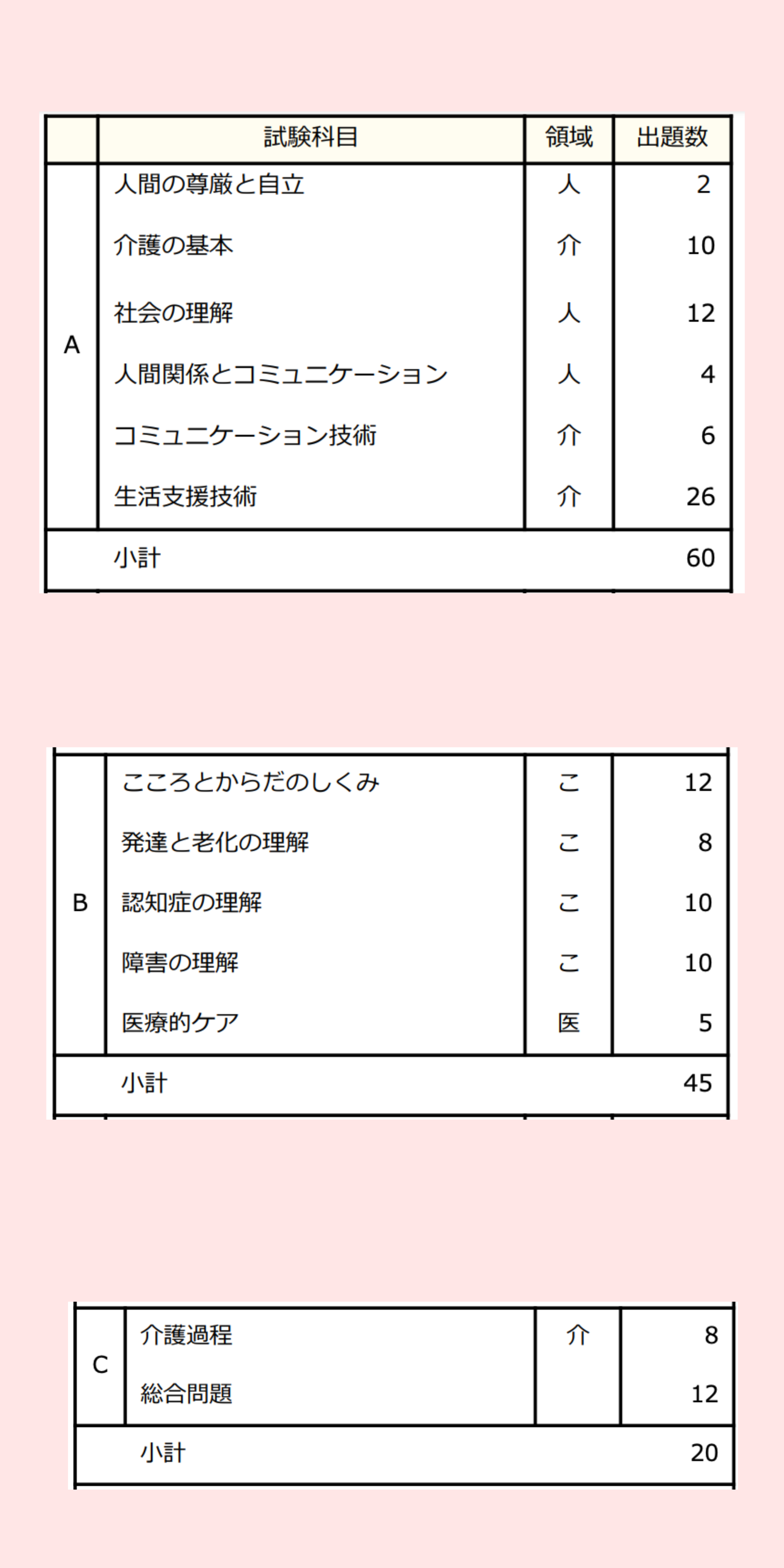
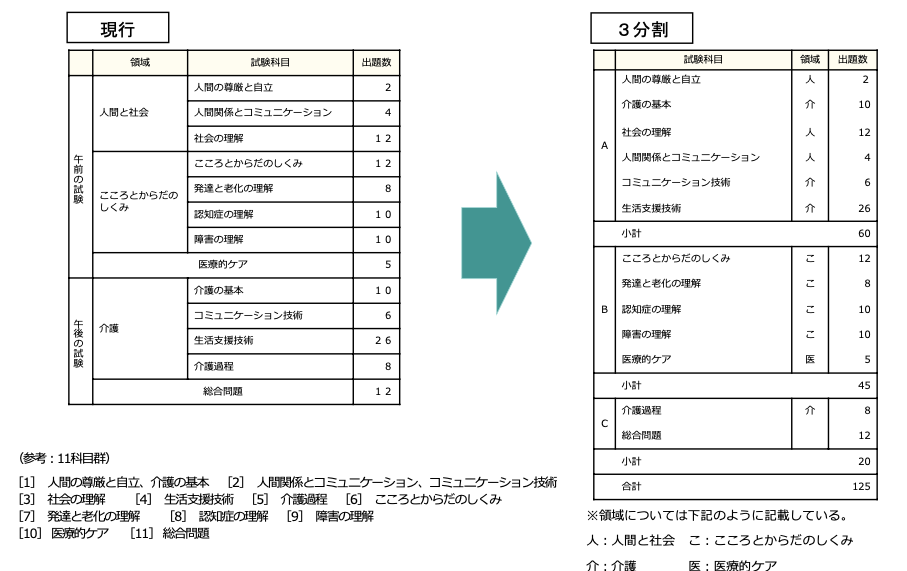
The examination will be divided into three parts from the viewpoint of ensuring the ease of study for examinees, while taking into consideration the burden on the administration of the examination.
Those who failed the part in the first year can focus on studying the part they failed in the next and subsequent years, thus expanding study options according to each individual's situation.
This will expand the study options for each student.
Q3. Change in Exam PatternPart Pattern.
Q4. How Exam is operated on the day of the examination?
Answer:-
If the test is simply divided into three parts by the method used to divide the test into morning and afternoon sessions, the time required to administer the test will increase due to the additional time required for explanation before the test and the time required to move the test room for each part of the test.
time required to conduct the exam (i.e., the exam start time needs to be earlier and the exam end time needs to be later).
The time required to administer the exam will increase (earlier start time and later end time will be necessary).
Since this will be to the disadvantage of the examinees, the following methods of administering the examinations will be used to avoid, as much as possible, an increase in the burden on examinees.
The examination will be held in the morning for Part A, and in the afternoon for Parts B and C, Part B and Part C (starting at the same time) (set according to the number of examinees at each venue).
(The time schedule will be determined by the situation of the examinees at each site).
The B and C parts of the examination will be administered consecutively, and examinees who are eligible to take only the B or C part of the examination will be asked to leave the examination room immediately after the examination time is over.
Exit the examination venue immediately after the end of the examination time.

Q5. How to take the examination?
Answer:-
The first time you take the examination, take all parts.
On the next and subsequent occasions, the examinee may choose to take all parts of the examination, including the parts already passed, or only those parts for which he/she has failed.
The next and subsequent times, examinees may choose whether to take all parts of the examination, including those parts already passed, or only those parts that they failed.
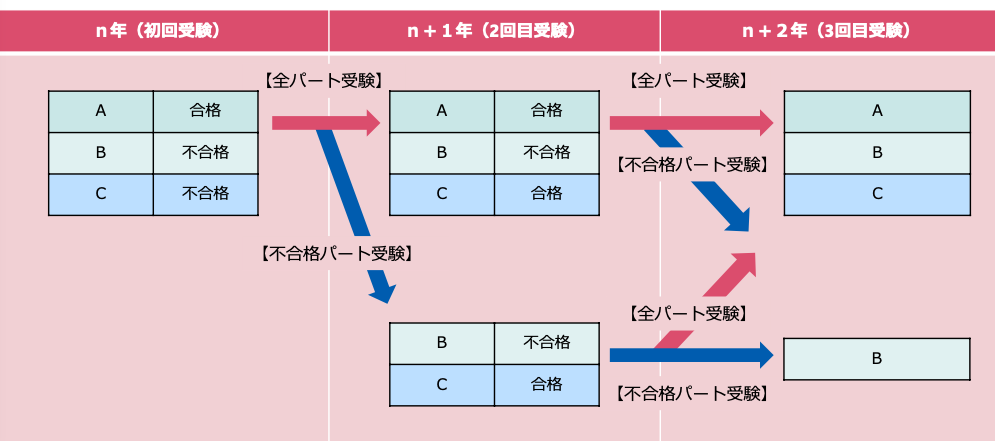
Note : Since the 38th examination in FY2025 was the first examination after the introduction of the “Part Pass” system, all examinees took all parts of the examination.
Q6. About expiration dates
Answer:-
Each part is valid from the last year in which the part is passed to the next and following year (2 years).
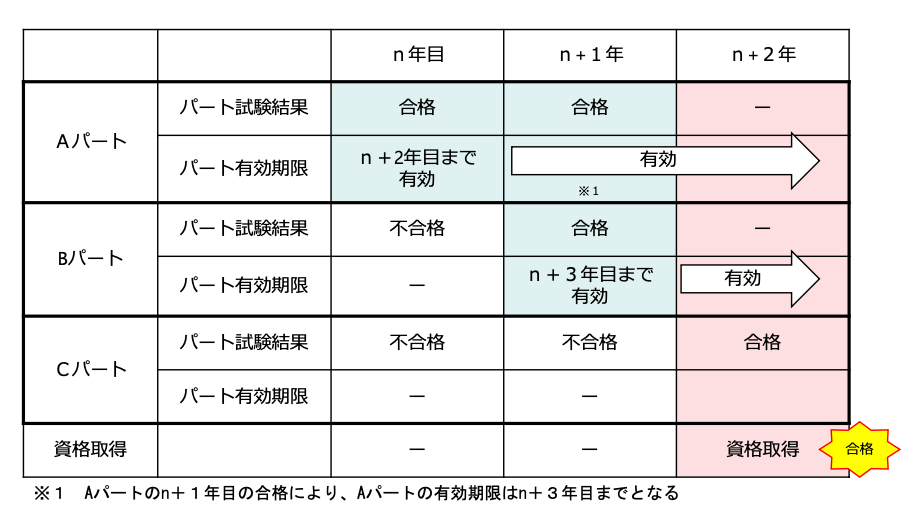
Note : 1 Passing of the n+1 year of Part A will make Part A valid until the n+3 year
Q7. Organize pass/fail decision pattern
Answer:-
The total score for a question is based on about 60% of the total score of the question.
The score is adjusted for the difficulty level of the question. (Scores in all 11 subject groups).
Examination passing score determine:
The overall passing standard is the average score of those who took all parts of the examination.
The overall passing score is proportionally divided by the ratio of the average score of the examinees who took all parts of the examination.
The score for all the subject groups that make up each part.
Pass/fail judgment:
If all parts are taken:
First, a decision is made based on the total score of all parts.
If the total score is not acceptable, the next step is to determine the score for each part.
When only the failed part is taken:
Judgment will be made based on the respective scores for each part.
Features:
Students can choose to take all parts of the exam or just the parts they have not passed, allowing them to plan their study according to their exam style.
This enables students to study systematically in accordance with their examination style.
Even with the introduction of (1) and (2), the pass/fail judgment for (1) will be the same as the conventional pass/fail judgment, and for (2), the independent pass/fail judgment will be made using the pass criteria set for each part.
The quality of the examinations will be ensured as a result of the introduction of (1) and (2).
The system is not too complicated.